Skip to content
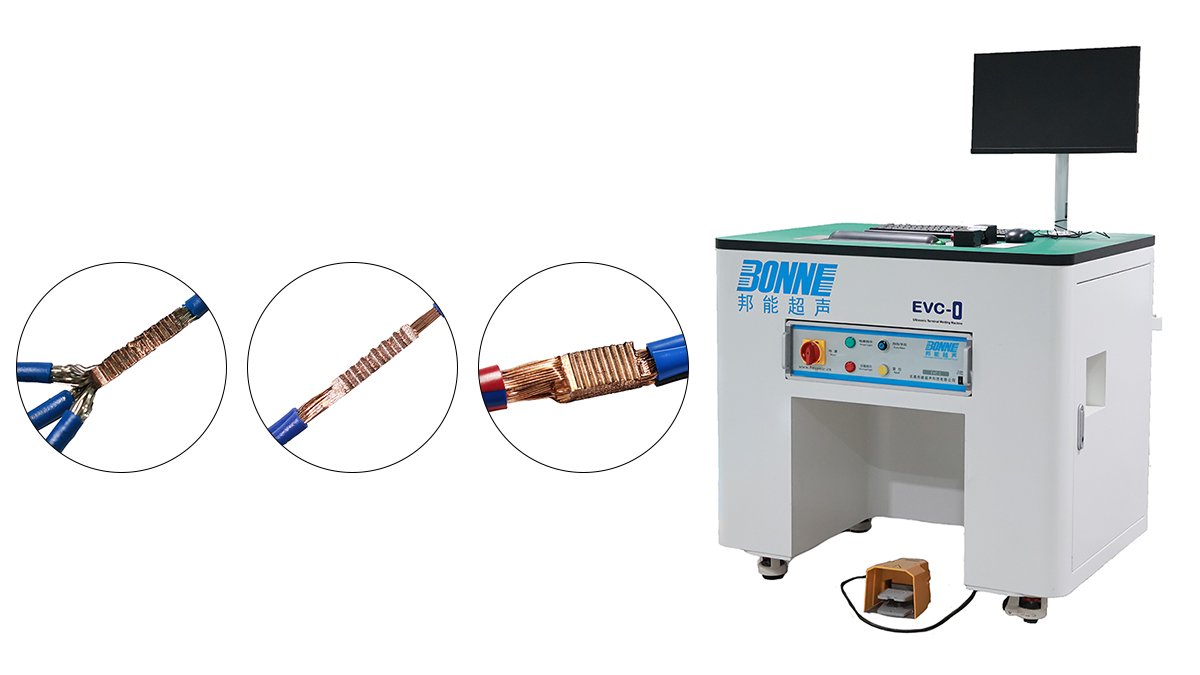
Selecting the correct ultrasonic wire harness welding machine is a critical step for automotive wire harness manufacturers, especially for EV high-voltage cables, battery connection systems, and power distribution applications.
Many buyers face the same questions before purchasing ultrasonic metal welding equipment:
- How much ultrasonic power is required for my cable size?
- Should I choose a 20kHz or 30kHz ultrasonic welding machine?
- Can one machine handle different wire cross sections?
- How can I ensure stable welding quality for mass production?
The answer depends not only on cable size but also on material, cable structure, welding requirements, and production conditions.
As a professional ultrasonic metal welding machine manufacturer, BONNE provides complete solutions including equipment development, manufacturing, welding process testing, installation support, and after-sales service for global automotive and EV customers.
[Ultrasonic Wire Harness Welding Machine → Product Page]
Why Ultrasonic Welding Machine Power Selection Matters
Ultrasonic metal welding is a solid-state joining technology that creates a strong metallurgical bond through high-frequency vibration, pressure, and friction energy.
Unlike traditional welding methods, it does not require:
- Solder
- Filler materials
- Melting process
This makes ultrasonic welding highly suitable for automotive wire harness applications where manufacturers require:
- High electrical conductivity
- Reliable mechanical strength
- Low energy consumption
- Stable production quality
However, selecting incorrect machine power may cause problems such as:
- Insufficient weld strength
- Excessive wire deformation
- Unstable electrical resistance
- Reduced tooling lifetime
Therefore, professional power selection is essential before equipment investment.
How Cable Cross Section Determines Ultrasonic Welding Machine Power
The maximum wire cross-section area is one of the most important parameters when selecting ultrasonic welding equipment.
Generally, larger cable sizes require:
- Higher ultrasonic energy output
- Stronger vibration force
- More powerful welding system
- Customized sonotrode and anvil design
Typical applications include:
| Cable Size | Typical Applications | Equipment Requirement |
|---|---|---|
| 0.35–6 mm² | Automotive low voltage harness | Standard ultrasonic wire welding system |
| 6–35 mm² | EV cables and battery connections | Medium power ultrasonic welder |
| 35–120 mm² | High voltage automotive harness | High-power ultrasonic welding equipment |
| 120 mm²+ | Special power cables | Customized welding solution |
However, cable size alone cannot determine the correct machine model.
A professional supplier must also evaluate:
- Cable material
- Number of wire strands
- Terminal design
- Required pull force
- Production cycle time
[Automotive Wire Harness Welding Solutions → Application Page]
Key Factors Affecting Ultrasonic Welding Machine Selection
Copper, Aluminum, and Copper-Aluminum Welding Applications
Different materials require different ultrasonic welding parameters.
Copper Wire Welding
Copper is widely used in automotive electrical systems due to its excellent conductivity.
However, copper wire welding requires:
- Precise amplitude control
- Stable vibration output
- Proper welding pressure
- Optimized tooling design
Applications include:
- Automotive wiring harnesses
- EV power cables
- Battery connection systems
Aluminum Wire Welding
Aluminum is increasingly used in EV applications because of its lightweight advantages.
Compared with copper, aluminum requires more precise process control due to its oxide layer characteristics.
A suitable ultrasonic welding system helps achieve:
- Reliable electrical connection
- Stable mechanical strength
- Reduced material damage
Copper-Aluminum Dissimilar Metal Welding
With the development of electric vehicles, copper-aluminum connections are becoming more common.
These applications require:
- Customized welding parameters
- Advanced energy control
- Professional process validation
BONNE provides customized ultrasonic welding solutions based on customer cable structures and application requirements.
[Internal Link: EV Battery & Energy Storage Welding Solutions → Application Page]
Choosing Between 20kHz and 30kHz Ultrasonic Welding Machines
20kHz Ultrasonic Welding Machine
20kHz systems are commonly used for larger wire cross sections because they provide:
- Higher welding force
- Stronger energy output
- Better performance for heavy cables
Typical applications:
- EV high-voltage wire harness
- Large copper cables
- Battery power connections
30kHz Ultrasonic Welding Machine
30kHz systems are suitable for smaller and medium-sized wire harness applications.
Advantages include:
- Higher precision
- Compact structure
- Faster response
Typical applications:
- Automotive terminals
- Small cable assemblies
- Precision wire connections
The correct frequency selection depends on the complete welding process rather than cable size alone.
Common Mistakes When Purchasing Ultrasonic Wire Welding Equipment
Choosing Machine Power Only Based on Cable Size
A larger machine is not always the best solution.
Excessive ultrasonic energy may result in:
- Damaged wire strands
- Poor welding appearance
- Increased tool wear
The correct selection should balance:
Cable Size + Material + Welding Structure + Production Requirements
Ignoring Welding Tool Design
An ultrasonic welding system is not only about the generator.
The complete system includes:
- Ultrasonic generator
- Converter
- Booster
- Sonotrode
- Anvil
- Control system
Tool design directly affects:
- Energy transmission efficiency
- Welding consistency
- Tool service life
BONNE develops and manufactures customized welding tools according to customer applications to ensure stable production performance.
Buying Equipment Without Technical Support
For industrial customers, purchasing equipment is only the beginning.
A reliable ultrasonic welding supplier should provide:
- Welding sample testing
- Process optimization
- Equipment installation support
- Technical training
- Long-term after-sales service
BONNE works with customers from initial welding evaluation to mass production implementation.
Why Choose BONNE as Your Ultrasonic Welding Equipment Partner
BONNE specializes in the development and manufacturing of ultrasonic metal welding equipment for automotive, EV, and energy applications.
Our capabilities include:
Professional R&D and Manufacturing
BONNE provides:
- Independent ultrasonic welding equipment development
- Customized machine design
- Precision welding tooling manufacturing
- Complete equipment testing before delivery
Our engineering team continuously improves ultrasonic welding technology to meet modern manufacturing requirements.
Complete Automotive Wire Harness Welding Solutions
BONNE supports customers in:
- Low voltage wire harness welding
- High voltage EV cable welding
- Battery connection welding
- Copper and aluminum conductor welding
- Terminal welding applications
From laboratory testing to production line integration, BONNE helps customers achieve reliable and efficient welding processes.
How to Select the Right Ultrasonic Welding Machine
Before selecting equipment, customers should provide:
- Cable material
- Maximum cross-section area
- Wire structure
- Terminal design
- Required welding strength
- Production capacity requirements
Based on these factors, BONNE can recommend:
- Suitable ultrasonic frequency
- Machine power range
- Welding tooling design
- Process parameters
Conclusion
Selecting the correct ultrasonic wire harness welding machine power is essential for achieving stable production, reliable welding quality, and long-term equipment performance.
Although cable cross-section is an important reference, professional equipment selection requires a complete evaluation of material characteristics, welding structure, and production requirements.
As an experienced ultrasonic metal welding equipment manufacturer, BONNE provides complete solutions from R&D and manufacturing to technical support and after-sales service.
Whether you are producing automotive wire harnesses, EV high-voltage cables, or battery connection systems, BONNE can help you develop a reliable ultrasonic welding solution.