Skip to content
Electromagnetic Pulse Welding: The Cold-Weld Solution for Aluminum-to-Copper High-Voltage Connectors
As EV and high-end manufacturing push for lighter, stronger, and lower-resistance high-voltage connections, traditional crimping and fusion welding are starting to show their limits — especially when joining dissimilar metals like aluminum harnesses to copper terminals.
Is there a process that bonds these metals like a “cold weld,” without damaging the base material? Yes — and it’s quietly reshaping the industry. It’s called electromagnetic pulse welding (EMPT).
Why Traditional Processes Are Falling Behind
Two mainstream methods are commonly used to join high-voltage cables and terminals:
Mechanical crimping relies on heavy mechanical force to deform the metal. For large cross-section aluminum cables (95 mm² and above), the process becomes hard to control. Micro-gaps inside the joint raise contact resistance, and after long-term vibration, the connection tends to loosen.
Ultrasonic metal welding is a proven solid-state joining technology that creates a metallurgical bond through high-frequency vibration. It works very well for flat conductors and battery tabs, but it cannot be applied to tubular or barrel-type terminals.
Electromagnetic pulse welding is the technology that fills exactly this gap.
Four Core Advantages
1. Higher Strength, Lower Resistance
Joints produced by EMPT consistently outperform mechanical crimps in pull-out testing — by roughly 150% to 300%. This safety margin matters in EV high-voltage circuits during a crash event.
Because the process forms a true metallurgical bond, the air gap inherent to crimping disappears. Tests on 50 mm² cables show joint resistance drops by more than 40% compared with conventional steel-die crimping, which means less heat and lower energy loss under high current.
2. A True Cold Joining Process
EMPT does not melt the base material, so there is virtually no heat-affected zone:
- The aluminum conductor keeps its grain structure — no annealing, no softening.
- No brittle intermetallic compounds form between copper and aluminum, solving the classic problem of dissimilar-metal fusion welding.
- No spatter, no fumes, no shielding gas required.
3. Built for Lightweighting and Automation
4. Ideal for Aluminum-to-Copper Joining
Process Parameters: What Engineers Should Know
For high-voltage harness applications, modern equipment typically operates in the 28–30 kJ energy range, with a clearly defined process window for optimal joint quality.
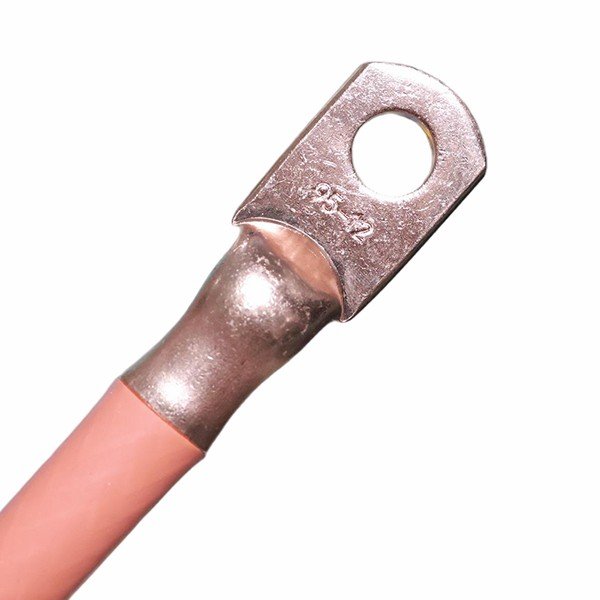
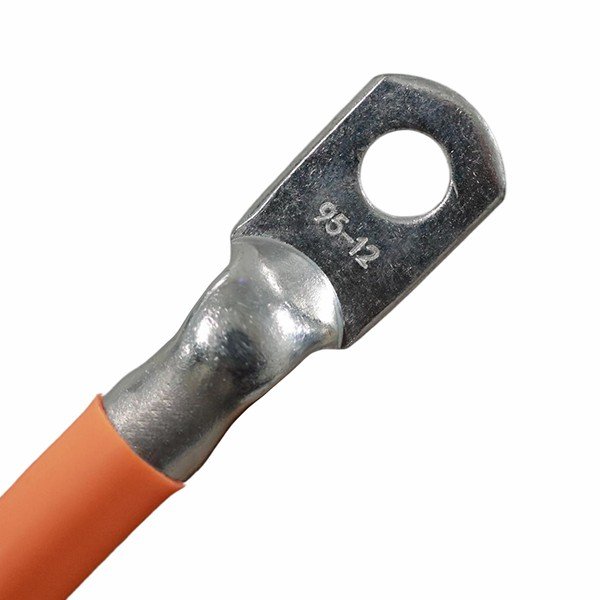
For example, in published research on the DTM-50 terminal, the best results appeared at 8–10 kV discharge voltage, corresponding to roughly 9.73–15.20 kJ of stored energy. Within this range, the Cu-Al interface forms the characteristic wavy and vortex-shaped pattern, indicating both mechanical interlocking and metallurgical bonding — without excessive work hardening.
These parameters are not universal. The optimal window depends on terminal geometry, wall thickness, conductor cross-section, and coil design. A reliable supplier should validate parameters through metallography, conductivity, and pull-out testing before production release.
From Lab to Mass Production
Final Thoughts
If your engineering team is dealing with aluminum crimp spring-back, low yield on dissimilar-metal welds, or rising contact resistance after thermal cycling, electromagnetic pulse welding may be the technology variable worth evaluating.