Skip to content
By Bonne Ultrasonic — Manufacturer of Certified Ultrasonic Metal Welding Systems for Automotive Wire Harness Applications
Why This Article Matters to Engineers and Buyers
If you are sourcing ultrasonic metal welding equipment for automotive wire harness production, EV battery tab bonding, or high-current terminal joining, you have probably run into the same recurring frustrations: inconsistent weld pull-force, premature sonotrode wear, frequency drift after long duty cycles, and — increasingly — certification gaps that block exports to North America and the EU.
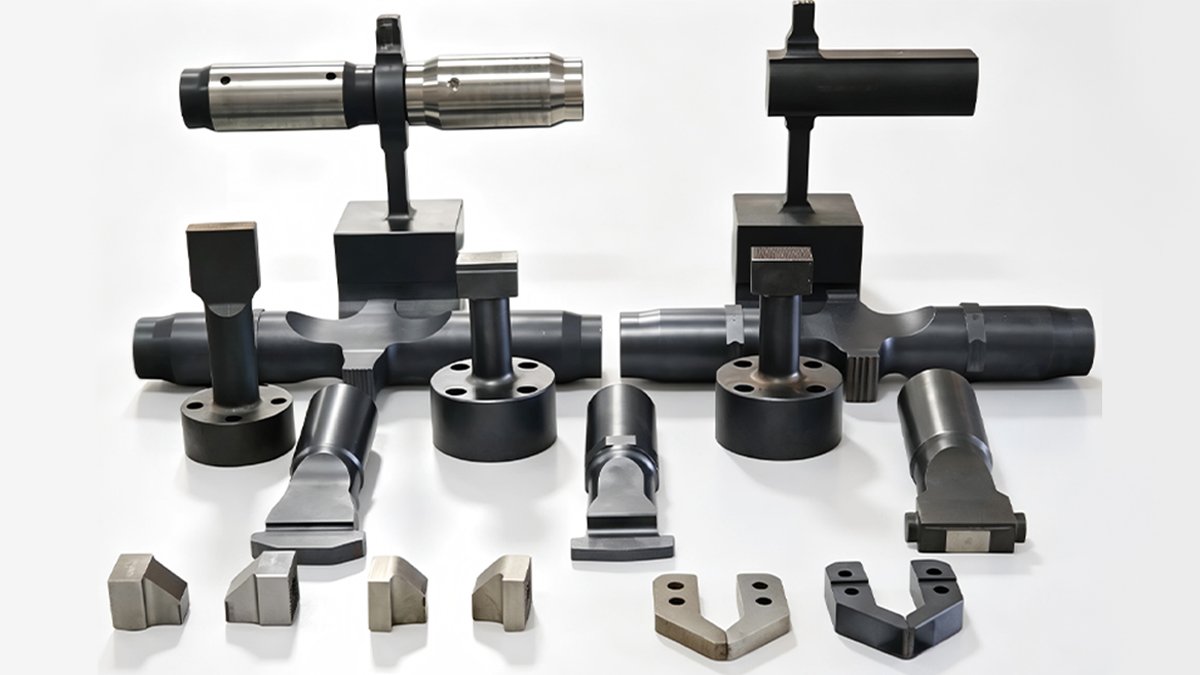
These problems rarely originate in the press frame or the HMI. They almost always trace back to three components that most suppliers treat as commodities, but that we at Bonne treat as the engineering core of every machine we build: the transducer, the booster (amplitude transformer), and the sonotrode (welding horn or tip).
This article explains how these three components work together, where the industry typically cuts corners, and what procurement teams in the US, Germany, Mexico, and Canada should verify before signing a purchase order.
1. The Acoustic Stack: A System, Not a Set of Parts
An ultrasonic metal welding machine converts 50/60 Hz line power into 20 kHz mechanical vibration that creates a solid-state metallurgical bond — no melting, no flux, no filler. The energy conversion path is:
Generator → Transducer → Booster → Sonotrode → Workpiece
Each stage either preserves or destroys energy. A weak link anywhere along this chain shows up at the weld joint as porosity, cold welds, or terminal cracking. This is why we refer to the transducer, booster, and sonotrode collectively as the acoustic stack — they must be tuned, machined, and certified as a coordinated system, not assembled from mixed-vendor parts.
This is also where buyers most often get burned. A machine may carry a “UL listed” sticker on the cabinet, while the components doing the actual welding work carry no certification at all. At Bonne, all four core components — generator, transducer, booster, and sonotrode — are 100% UL-certified. We refuse to ship “half-certified” systems, because in a 24/7 automotive harness plant, an uncertified component is an uninsured liability.
2. The Transducer: Converting Electricity into Precise Mechanical Motion
The piezoelectric transducer (also called the converter) turns the high-frequency electrical signal from the generator into longitudinal mechanical vibration at exactly 20 kHz, or 35/40 kHz for fine-wire applications.
What goes wrong in lower-tier transducers
Ceramic stack degradation under continuous duty. Cheap PZT ceramics lose polarization after a few million cycles, causing amplitude to drop by 10–15% — invisible to the operator, fatal to weld consistency.
Pre-stress bolt relaxation. If the titanium pre-stress bolt is under-torqued or made of substandard alloy, the stack loses compression and the resonant frequency drifts upward.
Heat buildup with no thermal management. Without proper air cooling channels, the transducer overheats during high-volume harness welding, triggering generator faults or, worse, silent performance loss.
How Bonne engineers the transducer
We use aerospace-grade PZT-8 ceramic rings, machined titanium front masses for fatigue resistance, and a closed-loop frequency-tracking generator that compensates in real time as the stack warms up. Each transducer is individually frequency-matched to its booster and sonotrode before leaving our facility — and each one carries its own UL certification, not a blanket cabinet-level sticker.
3. The Booster: The Amplitude Tuner Most Suppliers Ignore
The booster sits between the transducer and the sonotrode. Its job is to either amplify or reduce the vibration amplitude before it reaches the weld zone — typical ratios are 1:1.5, 1:2, or 1:2.5.
This sounds simple. It is not.
A booster that is dimensionally correct but acoustically mistuned will introduce standing-wave nodes in the wrong location, transferring vibration energy into the housing instead of the workpiece. The symptoms procurement teams describe — “the machine welds fine for the first hour, then quality drifts,” or “we get good welds at station 1 but not at station 3” — are almost always booster-related.
Common industry shortcuts
Many suppliers buy generic boosters from third-party machine shops, machine them to nominal dimensions, and ship them without resonance testing. The booster works, technically. But its performance window is narrow, and once the sonotrode wears even slightly, the whole stack falls out of tune.
Our approach
Every Bonne booster is CNC-machined from titanium alloy Ti-6Al-4V, dynamically balanced, and tested on a laser vibrometer to verify the amplitude profile along its length. We document the resonant frequency of every unit and ship it with a matched serial number to its transducer. This is the kind of traceability European Tier-1 automotive suppliers expect — and it is why our equipment passes IATF 16949 process audits without rework.
4. The Sonotrode: Where Metallurgy Meets Mechanical Engineering
The sonotrode (also called the horn, welding tip, or anvil tip depending on configuration) is the component that physically contacts the copper or aluminum strands. It is the most-replaced part on any ultrasonic metal welder, and it is where the gap between premium and budget machines becomes most visible.
The pain points buyers report most often
Sonotrode tip wear after 200K–400K welds — caused by soft tool steel and no surface treatment, leading to line stoppages and terminal scrap.Inconsistent weld nugget appearance — caused by poorly machined or unevenly worn knurl patterns, leading to failed pull-force tests and OEM rejections.Cracking of the sonotrode body — caused by incorrect heat treatment or stress concentration at the node, leading to sudden mid-shift failure and safety risk.Sticking of aluminum to the tip — caused by incorrect knurl geometry for the alloy, leading to continuous cleaning downtime.
How we engineer sonotrodes for automotive harness welding
For 0.13 mm² to 50 mm² automotive low-voltage harnesses (body and control system wiring), and for high-voltage EV harnesses up to 120 mm², we machine sonotrodes from proprietary tool steel grades with case-hardened knurl patterns, then verify each tip’s geometry on a profilometer. The knurl pattern is application-specific: copper-to-copper, copper-to-brass terminal, aluminum-to-copper, and battery-tab welding all require different geometries.
A sonotrode is not a consumable to be bought from the cheapest supplier. It is a precision tool whose geometry directly determines whether your weld passes the OEM’s pull-force, cross-section, and resistance specifications.
5. What “Industry-Standard” Looks Like vs. What You Actually Need
Most ultrasonic metal welding suppliers operate on a basic assumption: get the machine welding, ship it, sell spare tips. The acoustic stack is treated as a black box.
We disagree. Based on years of supplying wire harness manufacturers across North America and Europe, here is what we believe procurement teams should demand:
- Component-level certification, not just cabinet-level. Ask explicitly: is the transducer UL-certified? The booster? The sonotrode? If the answer is vague, the certification is incomplete.
- Frequency-matched stacks with documented serial pairing. Mixed-vendor stacks drift. Matched stacks hold tolerance for years.
- Real-time amplitude and frequency monitoring built into the generator — not as an option, as standard.
- Application-specific sonotrode geometry, with documented knurl design for your wire gauge and terminal type.
- Transparent wear-life data under your specific duty cycle, not generic catalog claims.
6. Why Bonne Is Built Differently
We are not a trading company. We are a manufacturer in Wuxi, China, with in-house piezoelectric ceramic preparation, titanium machining, generator electronics design, and acoustic testing — the entire acoustic stack is engineered under one roof. This vertical integration is why we can guarantee:
- 100% UL certification across all four core components — generator, transducer, booster, sonotrode. No “half-set” certification. No export surprises at US or Canadian customs.
- Frequency stability under 24/7 production load — verified through accelerated life testing, not just bench-top spec sheets.
- Application engineering for automotive low-voltage harness, EV high-voltage harness, battery tab welding, and busbar bonding — with sonotrode designs developed specifically for each.
- Direct factory support for North American and European customers — including remote diagnostics and tooling lead times under three weeks.
Closing: The Weld Joint Is the Truth
In ultrasonic metal welding, the cabinet, the HMI, and the brand sticker are marketing. The transducer, booster, and sonotrode are the truth. They determine whether your line runs at 99.5% first-pass yield, or whether you spend Monday mornings debugging cold welds.
If you are evaluating ultrasonic metal welding equipment for a new automotive harness program, an EV battery line, or a capacity expansion in Mexico, Germany, or Poland, we invite you to ask us the hard questions about our acoustic stack. We will answer with serial numbers, certificates, and test data — not slogans.
Bonne Ultrasonic Technology Co., Ltd.
Wuxi, China | Ultrasonic Metal Welding Machines · Wire Harness Welders · Terminal Welders · Spot Welders · Electromagnetic Pulse Crimping Systems
Certified. Matched. Engineered for the next 10 million welds.