Skip to content

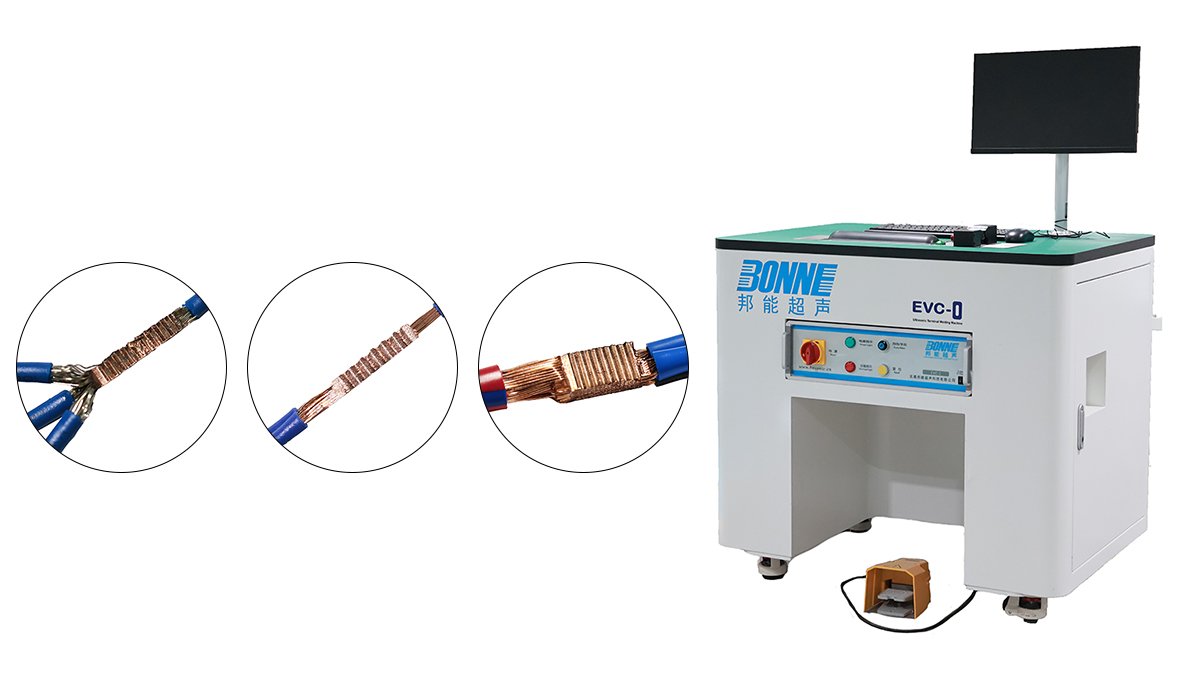
As automotive wire harnesses become more complex and production requirements continue to evolve, many large wire harness manufacturers are evaluating ultrasonic metal welding as an alternative to conventional resistance welding.
For process engineers, production managers, and procurement teams, the decision is not simply about replacing one machine with another. It is about improving connection quality, controlling production costs, and building a more consistent and traceable manufacturing process.
Why Are Wire Harness Manufacturers Considering Ultrasonic Welding?
Resistance welding uses electrical current to generate heat at the joint. Ultrasonic metal welding, by contrast, uses high-frequency mechanical vibrations combined with pressure to create a solid-state metal bond.
For suitable copper and aluminum wire applications, ultrasonic welding offers several potential advantages. Because the process does not rely on resistance heating to form the joint, it can reduce thermal impact on the surrounding materials and eliminate the need for welding electrodes used in resistance welding.
However, the right process depends on wire specifications, material combinations, joint geometry, and production requirements. Manufacturers should validate the welding results before changing an established production process.
Four Practical Benefits of Switching to Ultrasonic Wire Welding
1. More Consistent Connections and Quality Control
For high-volume automotive production, connection consistency is essential. Variations in welding conditions can affect electrical performance, mechanical strength, and downstream product reliability.
Ultrasonic wire welding can provide repeatable joining conditions when the equipment, tooling, and process parameters are properly controlled. Depending on the machine configuration, monitoring functions can also help manufacturers track welding parameters and identify process deviations.
For quality and engineering teams, the goal is to reduce process variation and establish a repeatable, verifiable joining process.
2. Lower Electrode-Related Maintenance Costs
Resistance welding electrodes are subject to wear and may require regular dressing, replacement, and maintenance. Electrode condition can also influence process consistency.
Ultrasonic metal welding does not use resistance-welding electrodes, which can reduce electrode-related consumable costs and maintenance requirements. Ultrasonic tooling still requires inspection and maintenance, so the overall cost benefit should be evaluated using actual production data.
For large manufacturers operating multiple production lines, even modest reductions in recurring maintenance can contribute to meaningful long-term savings.
3. Reduced Thermal Impact on Suitable Applications
Ultrasonic metal welding is a solid-state joining process. It creates a bond through mechanical vibration and pressure rather than relying on bulk melting of the base metals.
For suitable wire harness applications, this can help limit thermal damage to nearby insulation and other heat-sensitive components, subject to the specific joint design and process conditions.
This is particularly relevant when manufacturers need to join copper or aluminum conductors while maintaining the integrity of surrounding materials.
4. Better Process Monitoring and Production Traceability
Large automotive suppliers must meet demanding quality requirements and maintain effective production controls.
Depending on the equipment and software configuration, ultrasonic welding systems can monitor parameters such as welding energy, time, power, and displacement. These data can support process validation, fault detection, and production traceability when integrated into the manufacturer’s quality system.
For engineering and procurement teams, evaluating data availability, system integration, and documentation capabilities is an important part of equipment selection.
How Should Manufacturers Evaluate the Transition?
Switching from resistance welding to ultrasonic welding should begin with application testing rather than a machine purchase alone.
Manufacturers should evaluate:
- Material compatibility: Copper or aluminum conductors, wire cross-sections, strand construction, and surface condition.
- Joint performance: Electrical resistance, pull strength, and cross-sectional or metallographic results where required.
- Production capability: Cycle time, repeatability, tooling life, and suitability for the existing production line.
- Quality management: Process monitoring, parameter control, data recording, and validation requirements.
- Total cost of ownership: Equipment investment, consumables, maintenance, downtime, and expected production volume.
A controlled trial using representative production materials helps establish whether ultrasonic welding meets the required technical and commercial targets.
BONNE Ultrasonic Welding Solutions for Wire Harness Production
BONNE specializes in ultrasonic metal welding equipment for industrial metal joining applications, including automotive wire harness production.
Our ultrasonic wire harness welding machines support conductor welding applications across a range of wire sizes. The appropriate machine configuration depends on the conductor material, cross-section, joint requirements, and production process.
For manufacturers considering a transition from resistance welding, application testing can help assess weld quality, process stability, and suitability for production before equipment selection.
Contact BONNE to discuss your wire harness welding application and evaluate a suitable ultrasonic welding solution.