Skip to content

Why long-term weld consistency, intelligent process control, and production traceability matter more than speed alone in high-volume wire harness manufacturing.
When purchasing an ultrasonic wire harness welding machine, manufacturers naturally compare equipment prices, welding speeds, and production capacity.
Reducing initial investment costs is important. Improving production efficiency is equally important.
But there is another question that deserves just as much attention:
Will your ultrasonic welding machine maintain consistent weld quality when production volume doubles?
For automotive wire harness manufacturers supplying OEMs and Tier 1 suppliers, this is not just a technical question. It directly affects production efficiency, quality management, and long-term manufacturing costs.
A machine may deliver excellent welding results during initial sample testing. But maintaining those results across thousands of welding cycles, multiple production shifts, and growing production volumes is a different challenge.
As production scales, equipment performance alone is not enough. Manufacturers also need reliable parameter management, process control, and production traceability.
This is where the real value of an ultrasonic welding solution becomes clear.
1. The Real Cost of Ultrasonic Welding Is More Than the Purchase Price
A lower equipment price may reduce initial investment, but it does not necessarily mean lower long-term production costs.
In high-volume manufacturing, even small variations in welding performance can create additional costs.
Consider what happens when a welding process is not properly controlled:
- Inconsistent weld quality increases the need for inspection and rework.
- Unstable welding parameters may require frequent manual adjustments.
- Tooling wear can gradually affect welding conditions.
- Poor parameter management makes it difficult to reproduce qualified welding processes.
- Limited production traceability makes quality investigations more complicated.
These problems may not be obvious during a short equipment demonstration or initial sample test.
However, their impact can become more significant as production volumes increase.
For manufacturers operating multiple welding stations or production lines, the cost of inconsistent processes can extend beyond individual defective welds. It can affect overall equipment efficiency, production planning, and quality management.
The right equipment investment should be evaluated by its ability to support stable production over time — not simply by its initial purchase price.
2. Why Welding Consistency Becomes More Challenging in High-Volume Production
Ultrasonic metal welding is a solid-state joining process that uses high-frequency mechanical vibration and pressure to create metal-to-metal connections.
It is widely used in automotive wire harness manufacturing because it can join copper and aluminum conductors without solder or additional filler materials.
However, consistent welding requires several process conditions to work together.
Some important factors include:
Welding amplitude
Ultrasonic vibration conditions influence the energy transferred to the welding interface. Appropriate amplitude settings must be established according to the material and application.
Welding pressure
Pressure affects the contact conditions between the conductors and welding tooling. Variations can influence the resulting weld quality.
Welding time and energy
Incorrect parameter settings may lead to insufficient or excessive welding. These parameters should be validated for each application.
Horn and anvil condition
Welding horns and anvils are exposed to repeated mechanical loading. Wear and changes in tooling condition may influence welding performance over time.
Equipment calibration
The ultrasonic generator, transducer, booster, and welding horn must operate as a properly matched system. Their condition and calibration are important for maintaining stable operation.
In high-volume production, these factors deserve continuous attention.
A process that works well during initial commissioning should not simply be assumed to remain unchanged throughout the equipment’s service life.
Regular inspection, parameter verification, and appropriate maintenance are essential parts of long-term process control.
3. From Operator Experience to Intelligent Process Management
In smaller production environments, operators may rely heavily on experience to adjust welding parameters and manage production.
But as manufacturing operations expand, this approach becomes increasingly difficult to maintain.
Different operators, shifts, production lines, and product specifications can introduce additional management challenges.
For large-scale automotive wire harness manufacturers, process consistency should be supported by equipment functions rather than depending entirely on individual operating experience.
Modern ultrasonic welding systems can incorporate several functions to improve production management.
Intelligent Error Correction
Welding horn wear can influence the ultrasonic welding conditions over time.
BONNE systems incorporate intelligent error correction algorithms designed to help compensate for parameter variations associated with horn wear.
This function helps support more stable welding conditions during production.
Parameter Protection and Traceability
Uncontrolled parameter changes can create unnecessary risks in production.
Password-protected parameter settings help restrict unauthorized adjustments and maintain control over qualified welding conditions.
Parameter management also supports production traceability and more structured process control.
MES Integration Support
For manufacturers operating connected production environments, equipment-level data management is an important consideration.
BONNE ultrasonic welding systems support MES integration, enabling parameter management within connected manufacturing systems.
This helps manufacturers align welding equipment with broader production management requirements.
Barcode and QR Code Scanning
Different wire harness products may require different welding specifications and process parameters.
Barcode and QR code scanning supports product identification and production process control, helping connect product information with the relevant manufacturing workflow.
Recipe Management
In supported KSK modular production workflows, BOM information can be automatically identified and the corresponding welding parameters recalled.
This helps reduce repeated manual parameter selection when switching between supported product specifications.
Sequence and Online Welding
Different manufacturers have different production line configurations.
BONNE systems support sequence welding and online welding workflows to accommodate different production requirements and line integration arrangements.
Together, these functions help manufacturers establish a more structured welding process, reduce dependence on manual adjustments, and improve production management as operations expand.
4. Scalability: Can Your Welding Equipment Support Future Production Growth?
Production scalability is not simply about increasing the number of welds per hour.
It also means maintaining proceshttps://bonnesonic.com/product-category/ultrasonic-wire-welder/s control when production requirements become more complex.
Before investing in an ultrasonic wire harness welding machine, manufacturers should consider several important questions.
Can one equipment platform support different wire specifications?
A suitable machine configuration should accommodate the required conductor materials and cross-sections.
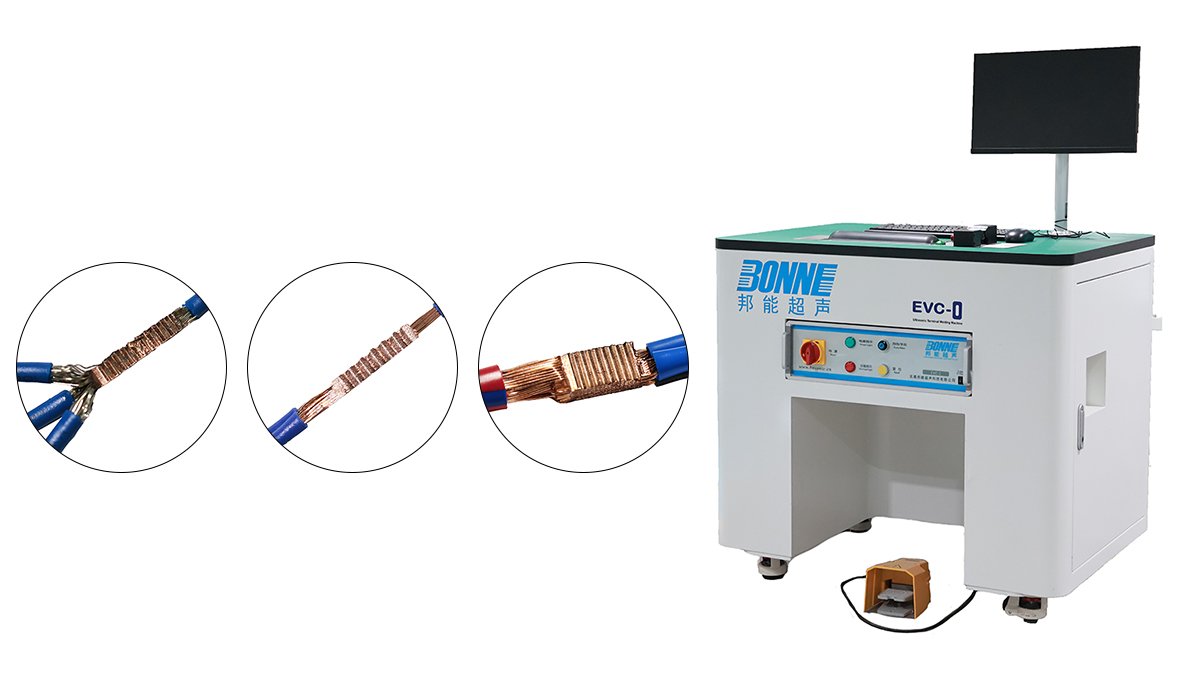
For example, BONNE’s EVC Series ultrasonic wire harness welding machines cover wire cross-sections from 0.13 mm² to 150 mm², depending on the selected model and application.
This provides manufacturers with options for different wire splicing requirements.
Can production parameters be managed systematically?
For manufacturers handling multiple product specifications, parameter protection, recipe management, and product identification can help reduce manual intervention.
Can the equipment integrate into existing production systems?
MES integration, barcode scanning, and online welding capabilities are worth considering when planning automated or connected production lines.
Can welding quality be verified objectively?
Equipment selection should include a clear validation process.
Depending on the application, this may involve:
- Pull-force testing.
- Electrical resistance measurement.
- Weld cross-section and metallographic analysis.
- Visual inspection of weld appearance and deformation.
- Process repeatability evaluation across production batches.
Can the supplier provide long-term technical support?
Equipment performance is only one part of a successful manufacturing solution.
Technical support, spare parts, tooling maintenance, troubleshooting, and application optimization also influence long-term production reliability.
A scalable welding solution should support both current manufacturing requirements and future production expansion.
5. What Should You Evaluate Before Purchasing an Ultrasonic Wire Harness Welding Machine?
For automotive wire harness manufacturers, equipment selection should go beyond comparing technical specifications and purchase prices.
The following checklist can help procurement and engineering teams evaluate different suppliers more effectively.
| Evaluation Criteria | Key Questions |
|---|---|
| Welding capability | Does the machine support your copper or aluminum wire specifications? |
| Process stability | Can qualified welding parameters be maintained during continuous production? |
| Intelligent control | Does the system offer error correction or other process control functions? |
| Parameter management | Are parameter protection and recipe management available? |
| Traceability | Can the equipment support production data management? |
| System integration | Does it support MES, barcode scanning, or online production workflows? |
| Quality validation | Can welding results be evaluated through pull-force and resistance testing? |
| Long-term support | Can the supplier provide tooling, maintenance, and technical assistance? |
One recommendation is particularly important:
Do not evaluate a welding machine only by testing a few samples.
Use your actual wire materials, cross-sections, and production requirements to conduct application testing.
Where necessary, extend the evaluation to include repeated welding tests, pull-force measurements, electrical resistance checks, and metallographic analysis.
The objective is to determine whether the proposed equipment configuration can meet your production requirements consistently — not simply whether it can produce one acceptable sample.
6. How BONNE Helps Wire Harness Manufacturers Build More Consistent Production Processes
BONNE is a professional manufacturer of ultrasonic metal welding equipment, focusing on industrial metal joining applications, particularly automotive wire harness manufacturing.
Our product range includes:
- Ultrasonic wire harness welding machines.
- Ultrasonic terminal welding machines.
- Ultrasonic spot welding machines.
We understand that large-scale manufacturers need more than a machine that can complete a welding operation.
They need equipment that supports production consistency, process management, and future manufacturing requirements.
That is why BONNE ultrasonic wire harness welding systems incorporate functions designed to support more structured production management:
- Intelligent Error Correction: Helps compensate for parameter variations associated with welding horn wear.
- Parameter Traceability: Password-protected settings support controlled parameter management.
- MES Integration Support: Enables integration with connected manufacturing systems.
- Barcode & QR Code Scanning: Supports product identification and production process control.
- Recipe Management: Supports automatic BOM identification and corresponding parameter recall in applicable KSK modular production workflows.
- Sequence & Online Welding: Accommodates different production workflows and line integration requirements.
For different wire splicing applications, the BONNE EVC Series covers 0.13 mm² to 150 mm², depending on the selected model.
For terminal welding applications, BONNE also provides customized welding tooling and equipment configurations based on specific wire and terminal designs.
Beyond equipment configuration, we support customers through application evaluation, sample welding tests, technical consultation, and equipment service.
Our focus is to help manufacturers select suitable ultrasonic welding equipment based on their actual production requirements.
Conclusion: Build Consistency into Your Production Process
Lower equipment costs and higher welding speeds are worthwhile objectives.
But for high-volume automotive wire harness manufacturing, long-term production consistency deserves equal attention.
Equipment calibration, intelligent error correction, parameter management, tooling maintenance, and production traceability all play important roles in supporting a controlled welding process.
As production expands, relying entirely on operator experience becomes increasingly difficult.
The better approach is to build process control into the equipment and manufacturing workflow from the beginning.
So, when evaluating your next ultrasonic wire harness welding machine, ask yourself one question:
Will this equipment simply help you produce more welds, or will it help you maintain consistent welding quality as your production grows?
Looking for an Ultrasonic Wire Harness Welding Solution?
Whether you are upgrading an existing production line, expanding manufacturing capacity, or evaluating ultrasonic welding for a new application, BONNE can help assess your requirements.
Tell us about your application:
- Material: Copper or aluminum?
- Wire cross-section: What sizes do you need to weld?
- Application: Wire splicing, terminal welding, or another metal joining requirement?
- Production requirements: What are your target output and process management needs?
Our technical team can help evaluate a suitable machine configuration and discuss sample welding tests using your actual materials.
Let’s discuss how BONNE can support your long-term production requirements.
Email: chen@bnsonic.com
Website: https://bonnesonic.com/
BONNE – Professional Ultrasonic Metal Welding Equipment Manufacturer