Skip to content
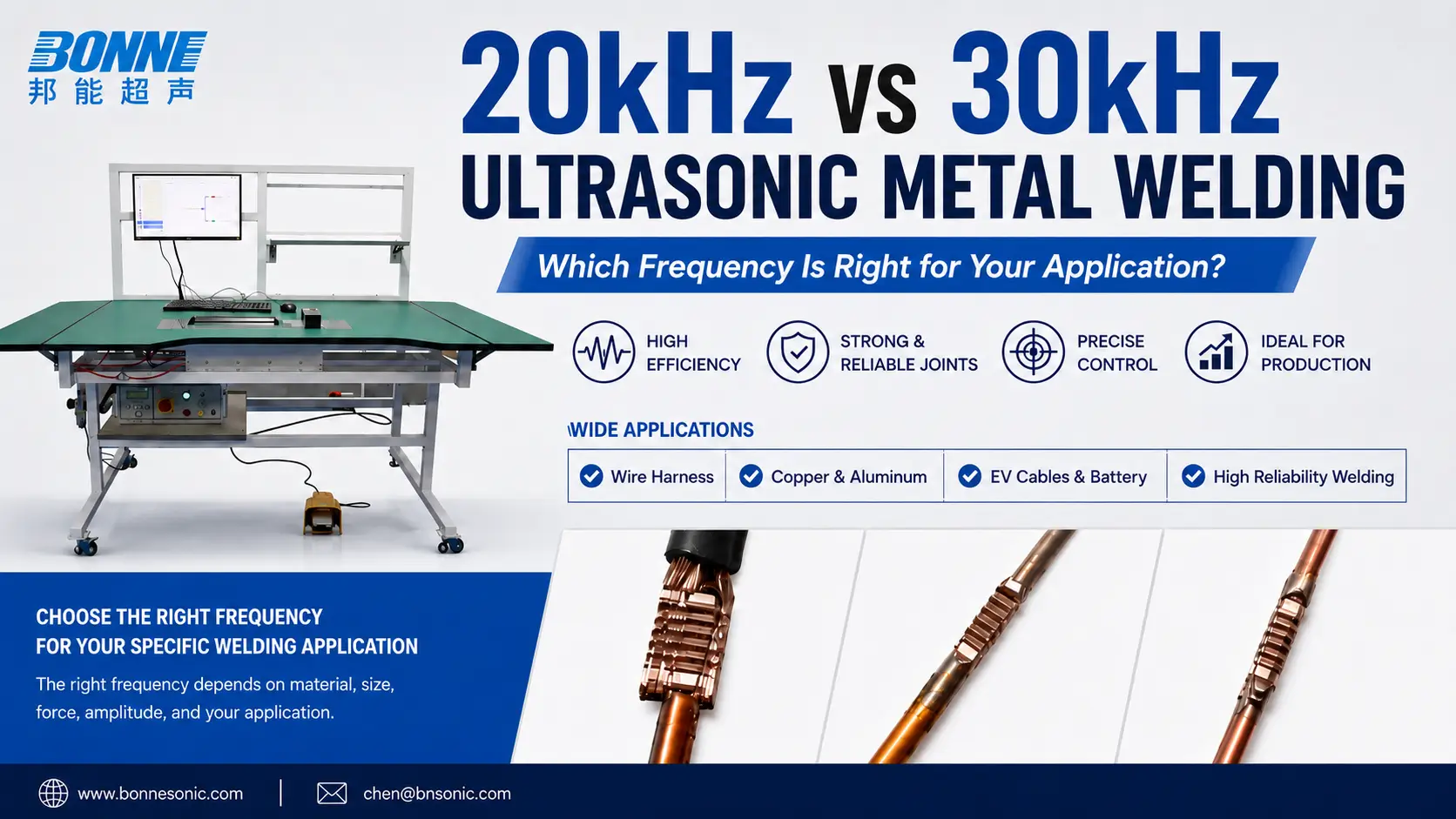
Choosing between a 20kHz and 30kHz ultrasonic metal welding machine is a common question for automotive wire harness manufacturers, EV battery manufacturers, and cable processing companies.
The right frequency is not simply determined by the material you want to weld. Cable cross-section, wire structure, welding force, required amplitude, tooling design, production volume, and joint requirements all affect the final machine selection.
For buyers comparing ultrasonic metal welding equipment, the key question is not “Which frequency is better?” but:
“Which frequency is better for my specific welding application?”
This guide explains the practical differences between 20kHz and 30kHz ultrasonic welding systems and what you should evaluate before purchasing a machine.
What Does Ultrasonic Welding Frequency Mean?
Ultrasonic welding systems use a transducer, booster, and sonotrode to convert electrical energy into high-frequency mechanical vibration.
In metal welding, common operating frequencies include 20kHz and 30kHz. The selected frequency affects the design and operating characteristics of the ultrasonic system, including the relationship between vibration amplitude, force, power, and tooling.
A simplified way to understand the difference is:
- 20kHz: generally better suited to higher-power and larger-section metal welding applications.
- 30kHz: generally better suited to smaller, more precise welding applications.
However, frequency alone does not determine welding capacity. A properly designed 30kHz system may outperform a poorly matched 20kHz system for a specific application.
20kHz vs 30kHz Ultrasonic Welding: Key Differences
| Factor | 20kHz | 30kHz |
|---|---|---|
| Typical application | Larger wire and metal joints | Smaller and precision joints |
| Available welding force | Generally higher | Generally lower |
| Power requirement | Suitable for higher-power systems | Suitable for lower-to-medium power applications |
| Typical wire harness use | Medium to large cross-sections | Small to medium cross-sections |
| Large copper cable | Excellent suitability | Application dependent |
| Fine wire applications | Possible, depending on tooling | Often more suitable |
| Tooling size | Generally larger | Generally more compact |
| Precision applications | Good | Often advantageous |
| Heavy-duty production | Strong choice | Better for suitable smaller applications |
These are general engineering tendencies rather than fixed rules. The actual welding range depends on the machine’s generator, transducer, booster, sonotrode, anvil, welding force, amplitude, and control system.
When Should You Choose a 20kHz Ultrasonic Welding Machine?
1. You Are Welding Larger Copper or Aluminum Cables
20kHz systems are commonly selected when the application requires higher energy and welding force.
For example, they can be suitable for:
- Automotive wire harnesses
- EV high-voltage cables
- Large stranded copper wires
- Aluminum cables
- Battery power connections
- High-current cable assemblies
For larger cable cross-sections, the welding process requires sufficient mechanical energy to create a stable bond throughout the joint.
This is one reason 20kHz is widely used in industrial metal welding systems.
2. You Need Higher Welding Force
For larger or more rigid workpieces, welding force becomes an important factor.
A 20kHz system is often preferred when the application requires a combination of:
High amplitude + high force + high ultrasonic power
This makes 20kHz a strong candidate for heavy-duty wire harness and cable welding.
3. You Are Building a Production-Oriented Wire Harness Line
If your application involves continuous production of medium or large cable assemblies, a 20kHz system may provide a better balance between welding capacity and machine robustness.
However, the machine should still be selected according to the actual cable structure and required weld area rather than frequency alone.
When Should You Choose a 30kHz Ultrasonic Welding Machine?
1. You Are Welding Smaller Wire Sections
30kHz systems can be a good option for smaller wire harness applications where extremely high welding force is not required.
Potential applications include:
- Small copper wires
- Fine-stranded wires
- Small terminals
- Compact electrical connections
- Precision wire assemblies
2. You Need More Compact Tooling
Higher-frequency systems can allow more compact ultrasonic components and tooling.
This can be useful when the welding area is small or when the machine needs to be integrated into a compact automated production system.
3. Your Application Requires More Precise Energy Control
For smaller components, excessive mechanical energy can become a problem.
A suitable 30kHz system may provide better process control for applications where the welding area is relatively small and the process window needs to be carefully controlled.
Is 20kHz Better Than 30kHz for Copper Wire?
Not necessarily.
This is one of the most important points for buyers.
Copper wire can be welded using different ultrasonic frequencies depending on the cable cross-section, strand structure, weld area, tooling design, and machine power.
For example:
- Small copper wires → 30kHz may be worth evaluating.
- Medium copper wire → 20kHz or 30kHz may both be possible.
- Large multi-strand copper cables → 20kHz is often the stronger candidate.
The correct decision should be based on actual welding tests rather than frequency specifications alone.
What About Aluminum Wire?
Aluminum has different mechanical and electrical characteristics from copper, so the welding process must be evaluated separately.
When welding aluminum cables or aluminum components, buyers should consider:
- Material grade
- Cable cross-section
- Strand structure
- Oxide layer
- Welding force
- Amplitude
- Weld time
- Sonotrode and anvil design
A 20kHz system is often considered when larger aluminum sections require higher welding energy and force.
However, the final frequency should be confirmed through sample welding and destructive testing.
How Does Wire Cross-Section Affect Frequency Selection?
Wire cross-section is one of the first specifications you should provide to an ultrasonic welding machine manufacturer.
For example:
| Wire Application | Frequency to Evaluate |
| Small wire | 30kHz |
| Small/medium wire | 30kHz or 20kHz |
| Medium wire harness | 20kHz or 30kHz |
| Large multi-strand cable | 20kHz |
| Large EV power cable | Usually 20kHz |
| Large copper/aluminum connection | Usually 20kHz |
These ranges are only starting points.
A professional equipment supplier should evaluate the actual cable structure, not simply recommend a frequency based on cross-section.
Frequency Is Not the Only Specification That Matters
Many buyers make the mistake of comparing machines only by frequency.
For ultrasonic metal welding, you should also compare:
Ultrasonic Power
A 20kHz machine with insufficient power may not be suitable for a large cable.
Likewise, simply increasing power does not guarantee better welding quality.
Welding Force
The welding head must provide stable and repeatable pressure during the welding cycle.
Amplitude
The required amplitude depends on the material, joint structure, tooling and welding conditions.
Sonotrode and Anvil Design
The horn and anvil directly transfer ultrasonic vibration and force to the workpiece.
Tooling geometry should be designed according to the wire size, material and weld configuration.
Welding Control
Look for control of parameters such as:
- Welding time
- Energy
- Welding force
- Amplitude
- Collapse distance
- Power
- Welding position
Stable process monitoring can be more important than simply choosing a higher or lower frequency.
20kHz vs 30kHz: Which One Should You Buy?
A practical decision process is:
Step 1 — Define the material
Copper, aluminum, nickel-plated components, or dissimilar metal combinations may require different process conditions.
Step 2 — Define the cable cross-section
Provide the minimum, maximum, and most common wire sizes you plan to weld.
Step 3 — Define the wire structure
Strand count and individual strand diameter can significantly affect the welding process.
Step 4 — Define the required weld size
The required weld width, length and joint configuration affect tooling and machine selection.
Step 5 — Define production requirements
Consider:
- Required cycle time
- Daily production volume
- Manual or automated loading
- Quality monitoring requirements
- Future product expansion
Step 6 — Perform sample welding
This is the most important step.
Before purchasing an ultrasonic metal welding machine, send representative wire samples to the equipment manufacturer and evaluate:
- Weld appearance
- Pull force
- Electrical resistance
- Cross-section
- Wire deformation
- Weld consistency
- Tooling wear
- Cycle time
A sample welding test can tell you much more than a machine specification sheet.
20kHz vs 30kHz: Quick Decision Guide
If you are still unsure, use this simple rule as a starting point:
Choose 20kHz when:
- You are welding larger cable cross-sections.
- Higher welding force is required.
- You are working with heavy-duty copper or aluminum cables.
- You are producing EV high-voltage or high-current cable assemblies.
- You need a production-oriented system for larger joints.
Consider 30kHz when:
- Your wire cross-section is relatively small.
- The welding area is compact.
- You need more compact tooling.
- The application requires controlled welding of smaller components.
- Extremely high welding force is not required.
But remember:
Frequency should be selected together with power, amplitude, force, tooling and the actual material application.
What Information Should You Send a Machine Manufacturer?
If you are requesting an ultrasonic welding machine quotation, providing only “I need a 20kHz machine” is usually not enough.
For a more accurate recommendation, provide:
- Material: Copper / Aluminum / Cu-Al / Other
- Wire cross-section: mm²
- Number of strands: if applicable
- Individual strand diameter: if available
- Wire configuration: parallel / twisted / bundled
- Required weld size
- Target cycle time
- Required production volume
- Pull force requirement
- Electrical resistance requirement
- Photos or drawings of the cable assembly
With this information, the manufacturer can recommend a more suitable ultrasonic frequency, power level and tooling configuration.
Final Recommendation
There is no universal answer that says 20kHz is better than 30kHz.
For ultrasonic metal welding, 20kHz is generally a strong choice for larger and higher-power applications, while 30kHz can be advantageous for smaller and more precision-oriented applications.
The final selection should be based on the complete welding system:
Material + Wire Size + Strand Structure + Welding Area + Force + Amplitude + Power + Tooling + Production Requirements
If you are comparing 20kHz and 30kHz ultrasonic welding machines for your wire harness, EV cable, battery, or terminal application, the safest approach is to test your actual materials before purchasing the equipment.
Need help selecting the right ultrasonic metal welding machine?
Send us your wire material, cross-section, strand structure, and welding requirements. Our engineering team can evaluate the application and recommend a suitable welding frequency, machine configuration and tooling solution.
BONNE Ultrasonic — Ultrasonic Metal Welding Solutions for Wire Harness & EV Applications
Website: bonnesonic.com
Email: chen@bnsonic.com