Skip to content
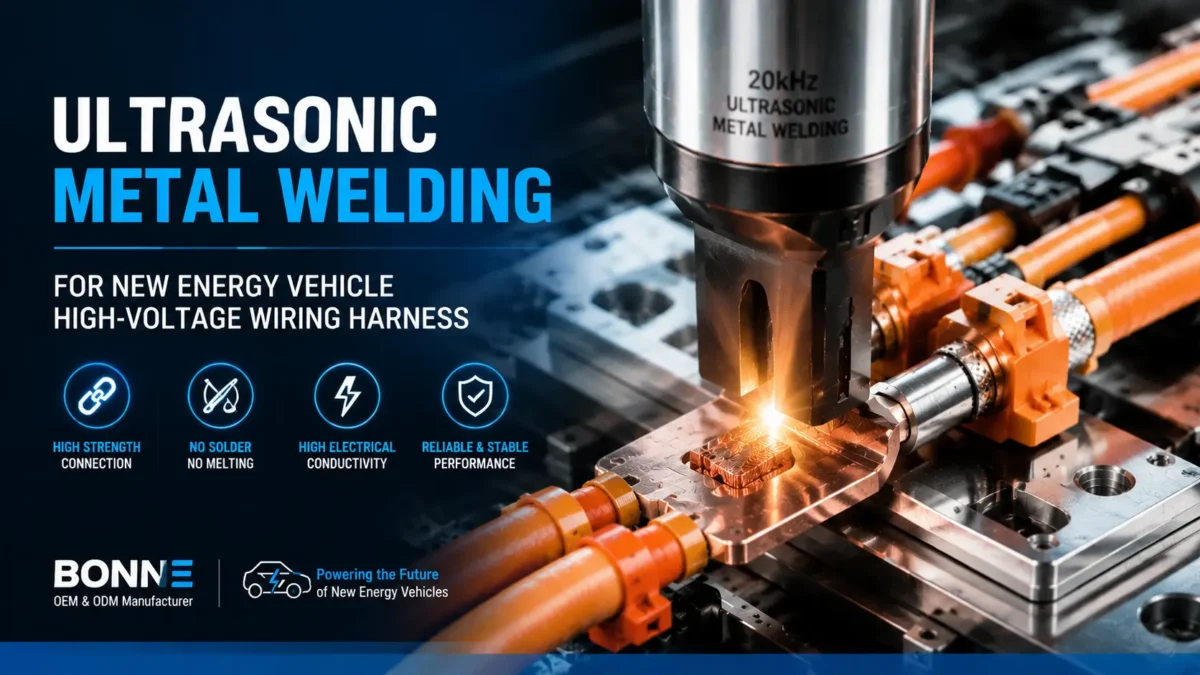
The global transition toward Electric Vehicles (EVs) has revolutionized automotive electrical architectures. Unlike traditional Internal Combustion Engine (ICE) vehicles that rely on low-voltage systems, modern EVs operate on high-voltage platforms ranging from 400V to over 800V. This shift places unprecedented demands on high-voltage wire harnesses, which are responsible for transmitting massive amounts of power between the battery pack, inverter, and electric motor.
For Tier 1 automotive suppliers and wire harness manufacturers, ensuring the absolute reliability of these high-voltage connections is non-negotiable. Traditional mechanical crimping and resistance welding often fall short when dealing with large cross-sectional areas and dissimilar metals.
As a premier direct manufacturer of industrial ultrasonic equipment, we break down the critical technical insights, industry pain points, and best practices for EV high-voltage wire harness ultrasonic welding.
Why Ultrasonic Welding is the Gold Standard for EV High-Voltage Wire Harnesses
High-voltage EV wire harnesses typically utilize heavy-gauge copper or aluminum wires with cross-sectional areas ranging from 15mm² to 70mm² or even higher. Joining these thick conductors to heavy-duty terminals requires a welding technology that minimizes electrical resistance and thermal stress.
Compared to alternative joining methods, Ultrasonic Metal Welding (UMW) offers distinct technical advantages:
- Solid-State Joint: UMW is a cold welding process. It does not melt the materials; inst
- ead, it uses high-frequency mechanical vibrations to disperse surface oxides and create a pure molecular bond.
- Ultra-Low Electrical Resistance: Because the joint is a true metallurgical bond without foreign filler metals, interfacial resistance is minimized, preventing localized overheating and thermal runaway during high-current EV operations.
- Dissimilar Metal Joining: It seamlessly welds aluminum wires to copper terminals—a critical requirement as EV manufacturers increasingly adopt aluminum for weight reduction.
Critical Pain Points in EV Wire Harness Manufacturing & How to Solve Them
Through our decades of experience as an OEM/ODM source factory, we have identified the primary challenges global buyers face during production. Here is how advanced ultrasonic technology addresses them:
1. Inconsistent Pull-Force Tests & Peel Strength
- The Pain Point: In mass production, variations in wire cleanliness, oxidation levels, or pressure stability often lead to inconsistent mechanical strength, causing batches to fail the mandatory Pull-Force Test.
- The Solution: Our advanced ultrasonic wire harness welding machines feature energy-mode and time-mode dual-control algorithms. The system automatically adjusts energy delivery in real-time based on the joint’s dynamic resistance, ensuring uniform peel and shear strength for every single weld cycle.
2. Tooling Wear and Wire “Sticking”
- The Pain Point: Welding large cross-section wires requires high amplitude and pressure. This accelerated mechanical stress often causes the welding horn (sonotrode) and anvil to wear out prematurely, or worse, cause the wire to stick to the tooling.
- The Solution: We utilize premium, imported tool steels treated with specialized surface-hardening coatings. Our proprietary tool knurl designs prevent wire slippage and eliminate sticking (adhesion) phenomena, significantly extending the lifespan of consumable components.
3. Strict Compliance with International Standards (USCAR-21 / SAE)
- The Pain Point: Entering the supply chain of global automakers requires strict adherence to international testing benchmarks.
- The Solution: Our machines are specifically engineered to assist manufacturers in meeting and exceeding USCAR-21, SAE, and USCAR-38 standards. Integrated data acquisition modules log key parameters—such as pre-weld height, final weld height, welding time, and power peak—providing full traceability for factory audits (FAT).
Core Process Parameters for High-Voltage Welding Optimization
Achieving a flawless high-voltage weld requires the precise synchronization of three primary variables, often referred to as the Welding Triad:
| Parameter | Impact on High-Voltage EV Harnesses | Optimization Strategy |
| Amplitude | Determines the mechanical scrubbing action needed to break oxide layers on heavy-gauge wires. | Typically optimized between 20 kHz to 35 kHz depending on the cross-sectional area (0.5 – 40 mm²+). |
| Welding Pressure | Ensures intimate contact between the wire strands and the terminal interface. | Must be dynamically regulated via high-precision pneumatic or servo systems to prevent strand damage. |
| Energy (Joules) | The total energy delivered to complete the metallurgical bond. | Monitored in real-time to detect “under-welding” or “over-welding” thresholds. |
Why Partner with Bonne Ultrasonic? Your Direct Source Factory Authority
When you partner with a direct manufacturer rather than a trading company, you gain access to deep engineering expertise and tailored technical support.
Engineered for Global Compliance: Full UL Machine Certification
We understand that Western and European procurement teams prioritize equipment safety and regulatory compliance. Unlike standard equipment suppliers, our machinery is fully capable of passing complete UL Machine Certification. This ensures seamless integration into your automated production lines, meeting all local safety and electrical regulations in North America and Europe.
End-to-End Solutions & Custom Tooling
We do not just sell machines; we deliver complete engineering solutions. From customized anvil and horn design based on your specific terminal drawings, to custom-built pneumatic fixtures for complex, multi-core high-voltage cables, our technical team provides full application laboratory testing (including cross-section metallographic analysis and pull testing) before your equipment ever leaves our facility.
Streamline Your EV Wire Harness Production Today
As the EV sector accelerates, your production line cannot afford compromises in joint integrity. Investing in robust, high-precision ultrasonic metal welding equipment is the most effective way to eliminate field failures, reduce cycle times, and secure your position in the tier-automotive supply chain.
Looking to optimize your high-voltage wire splicing or terminal welding line?
[Contact our engineering team today] to request a technical consultation, submit samples for free lab testing, or receive an immediate factory-direct quote.