Skip to content

For high-volume automotive wire harness production, the welding process directly affects production capacity, labor cost, quality and long-term manufacturing efficiency.
As automotive electrical systems become more complex, manufacturers need a joining technology that can provide fast cycle times, stable weld quality, low electrical resistance and reliable process control.
This is why ultrasonic metal welding is increasingly used for automotive wire harnesses, terminals, battery cables and other electrical connections.
The key question for engineers and purchasing teams is not simply whether ultrasonic welding can make a reliable connection.
It is:
Can ultrasonic welding help us produce more qualified parts at a lower total cost?
Why Ultrasonic Welding Fits Automotive Wire Harness Production
Ultrasonic metal welding is a solid-state joining process. Instead of melting the metals, high-frequency mechanical vibration and pressure create a metal-to-metal bond.
This makes the process particularly suitable for conductive materials such as copper and aluminum.
For automotive wire harness production, the main advantages include:
- Fast welding cycles
- Low heat input
- Stable electrical performance
- Copper and aluminum compatibility
- No solder or flux
- High repeatability
- Process monitoring
- Easy automation integration
These characteristics make ultrasonic welding especially suitable for high-volume production environments.


Shorter Cycle Time Can Increase Production Capacity
For large wire harness factories, cycle time is one of the most important production KPIs.
Even a small reduction in the total cycle time can significantly increase theoretical production capacity.
For example:
3.0 seconds/cycle → 1,200 cycles/hour
If the total cycle time is reduced to:
2.0 seconds/cycle → 1,800 cycles/hour
The theoretical capacity increases by 50%.
Actual production output will depend on wire positioning, feeding, loading, unloading and automation. Therefore, manufacturers should evaluate the complete production cycle, rather than looking only at ultrasonic welding time.
When ultrasonic welding is integrated with automatic wire positioning, feeding and handling, the welding station can become part of a highly automated production cell.
How Ultrasonic Welding Helps Reduce Production Costs
Machine purchase price is only one part of the investment.
For an automotive manufacturer, the more important metric is the Total Cost of Ownership (TCO).
Lower Labor Requirements
Automatic feeding, positioning and handling can reduce manual operations and operator dependency.
This can help reduce:
- Labor cost per part
- Operator-related variation
- Manual inspection requirements
- Production bottlenecks
For multi-shift production, these savings can become significant over the lifetime of the equipment.
Fewer Consumables
Ultrasonic metal welding does not require solder or flux for the joining process.
This can reduce consumable costs and simplify the production process.
When millions of connections are produced annually, even a small saving per weld can have a measurable impact on total manufacturing cost.
Less Scrap and Rework
A stable welding process combined with process monitoring can help identify abnormal welds before defective parts move to downstream operations.
Reducing scrap and rework is particularly important in automotive manufacturing, where the cost of a defect increases significantly once the part has entered subsequent assembly processes.
Why Ultrasonic Welding Is Suitable for Copper and Aluminum
Automotive electrical systems increasingly use both copper and aluminum conductors.
Ultrasonic welding can be developed for a variety of material combinations, including:
- Cu-Cu
- Al-Al
- Cu-Al
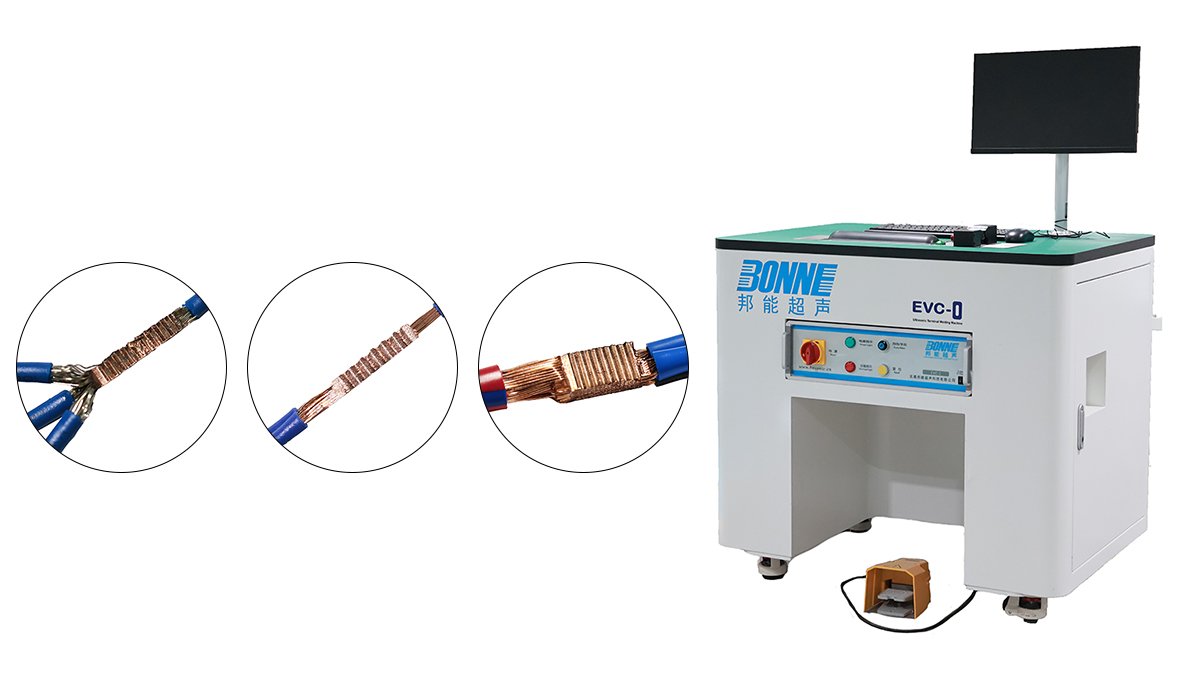
It is suitable for applications such as wire splices, terminals, battery cables, grounding connections and high-voltage harnesses.
Low Electrical Resistance
A reliable automotive connection needs stable electrical performance as well as mechanical strength.
Ultrasonic welding creates intimate metal-to-metal contact, making it suitable for applications where low electrical resistance and reliable current transmission are critical.
Low Heat Input
Because ultrasonic welding is a solid-state joining process, it does not rely on melting the conductors.
The relatively low heat input can help reduce thermal damage to wires, insulation and nearby components.
This is particularly valuable for fine-stranded conductors and automotive harness applications where thermal control is important.
Process Monitoring and Traceability
For large automotive suppliers, simply producing a weld is not enough.
Manufacturers increasingly need to know whether each weld was produced within the qualified process window.
Modern ultrasonic welding systems can monitor parameters such as:
- Welding energy
- Welding force
- Welding time
- Welding power
- Welding displacement
- Amplitude
These parameters can be used for process monitoring and OK/NG judgment.
Production data can also be connected with factory systems to support:
- Quality analysis
- Process optimization
- Preventive maintenance
- Production traceability
- Root-cause analysis
For automotive Tier 1 and Tier 2 suppliers, this level of process control can be an important part of production quality management.
Automation Is More Important Than Machine Speed Alone
For a large wire harness manufacturer, a fast welding machine does not automatically mean a fast production line.
The complete process should work together:
Wire Feeding → Positioning → Ultrasonic Welding → Quality Monitoring → OK/NG Separation → Data Recording
The welding system should also be able to communicate with production equipment such as PLCs, MES and automated handling systems when required.
This is why engineers should evaluate not only welding speed, but also the machine’s automation capability and integration flexibility.
How Should Engineers Compare Ultrasonic Welding Machines?
When evaluating different suppliers, purchasing price should not be the only consideration.
A professional comparison should include:
Welding Capability
- Wire cross-section
- Copper and aluminum capability
- Cu-Cu / Al-Al / Cu-Al applications
- Wire-to-wire welding
- Wire-to-terminal welding
Production Performance
- Total cycle time
- Production capacity
- Automatic feeding
- Changeover time
- Multi-product capability
Quality Control
- Welding energy monitoring
- Force monitoring
- Displacement monitoring
- OK/NG judgment
- Data recording and traceability
Long-Term Cost
- Labor
- Energy
- Tooling
- Maintenance
- Spare parts
- Scrap and rework
- Technical support
The lowest machine quotation does not necessarily represent the lowest production cost.
For a high-volume automotive plant, the more useful KPI is:
Cost per qualified part.
Conclusion: Evaluate the Complete Production System
Ultrasonic metal welding can provide automotive wire harness manufacturers with more than a reliable electrical connection.
When properly engineered and integrated into the production line, it can help manufacturers achieve:
Shorter cycle times + higher production capacity + lower labor requirements + stable weld quality + better traceability
For high-volume production, the right question is therefore not:
“Which welding machine is cheapest?”
It is:
“Which welding system can produce the highest number of qualified parts at the lowest total cost?”
That is the real value of ultrasonic metal welding for modern automotive wire harness production.
About BONNE Ultrasonic
BONNE Ultrasonic is a manufacturer of ultrasonic metal welding equipment for automotive wire harnesses, terminals, battery applications and other electrical connections.
Our ultrasonic wire harness welding solutions cover applications from 0.13 mm² to 150 mm², supporting a wide range of copper and aluminum wire configurations.
BONNE provides equipment manufacturing, application support and after-sales service for customers looking to improve welding quality, production efficiency and automation.
Website: bonnesonic.com
Email: chen@bnsonic.com