Skip to content
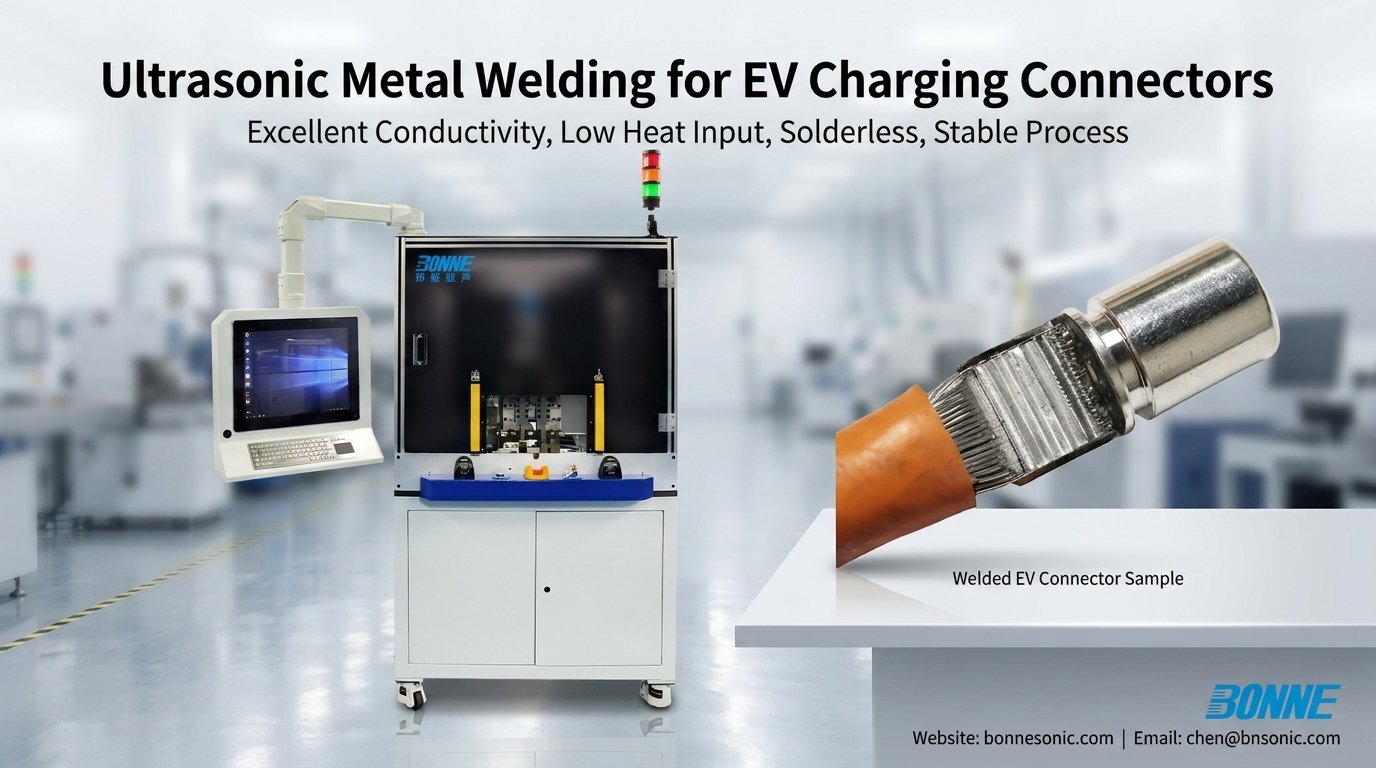
As electric vehicles continue to expand worldwide, manufacturers of EV charging connectors are facing higher requirements for electrical conductivity, connection reliability, production consistency, and manufacturing efficiency.
For these applications, choosing the right ultrasonic metal welding machine can have a direct impact on product quality and production performance.
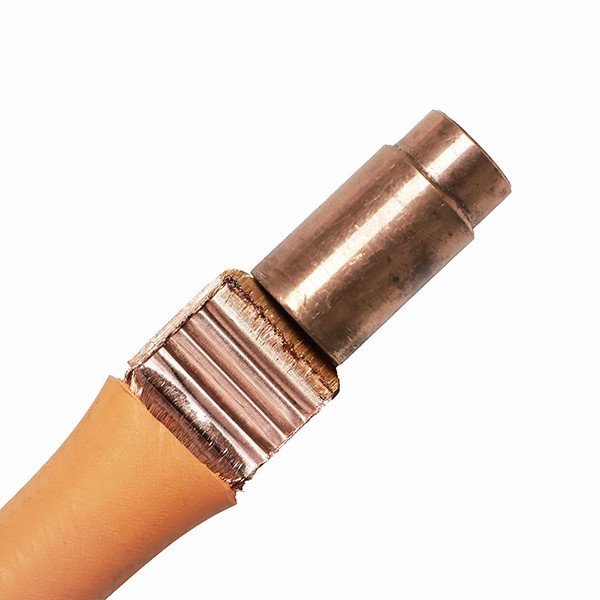
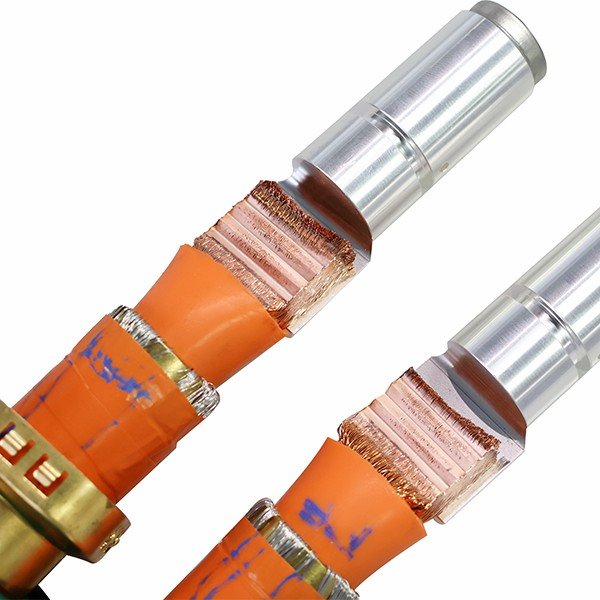
Ultrasonic metal welding is particularly suitable for joining copper wires, terminals, busbars, and other conductive components used in EV charging connectors.
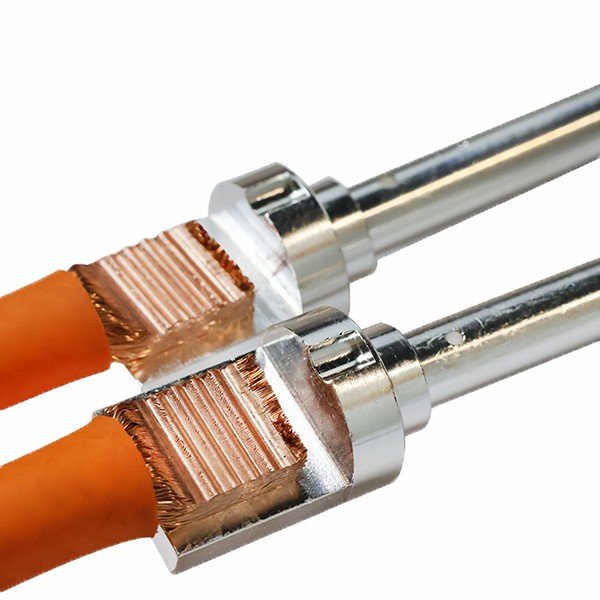
Why Is Ultrasonic Welding Suitable for EV Charging Connectors?
EV charging connectors need to carry relatively high electrical currents while maintaining stable performance over long periods of use.
The quality of the metal connection is therefore critical. Depending on the connector design, manufacturers may need to join:
• Multi-strand copper wires
• Copper terminals
• Copper busbars
• Copper-to-copper components
• Other conductive metal parts
Compared with conventional thermal joining processes, ultrasonic metal welding offers several advantages for these applications.
5 Advantages of Ultrasonic Metal Welding
1. Excellent Electrical Conductivity
Electrical resistance is an important consideration when manufacturing EV charging connectors.
Ultrasonic metal welding creates a solid-state metal bond through high-frequency mechanical vibration and controlled welding force.
When the material, tooling, and welding parameters are properly matched, the process can produce a reliable, low-resistance electrical connection.
This makes ultrasonic welding a suitable technology for copper conductors and other conductive components used in EV charging systems.
2. Low Heat Input
Unlike conventional fusion welding, ultrasonic metal welding does not require the entire joint to be melted.
The relatively low heat input can be beneficial when welding components located close to wire insulation, plastic connector housings, sensitive electrical components, or thin metal parts.
For EV charging connector manufacturers, controlling heat can help reduce the risk of thermal damage around the welding area.
3. No Solder or Flux
An ultrasonic metal welding machine can create a metal-to-metal connection without solder, flux, or other filler materials.
This can simplify the production process and reduce the need for additional consumables.
For automated manufacturing, fewer process materials can also make production management easier.
4. Suitable for Multi-Strand Copper Wire
Many EV charging cables use flexible multi-strand copper conductors.
Joining multiple strands consistently can be challenging with some traditional processes.
Ultrasonic welding is well suited to this type of application because ultrasonic vibration helps consolidate the individual copper strands into a stable welded joint.
Typical applications include:
• EV charging cables
• Charging connector wire assemblies
• Copper wire-to-terminal connections
• High-current cable assemblies
The actual welding capability depends on cable cross-section, strand structure, conductor material, terminal design, and tooling.
5. Consistent Production Quality
For high-volume EV charging connector production, producing one good weld is not enough.
Manufacturers need a process that can maintain stable results over thousands or millions of production cycles.
A properly configured ultrasonic metal welding machine can monitor and control parameters such as welding energy, welding force, amplitude, welding time, and displacement.
This allows manufacturers to establish a repeatable welding process and improve production quality control.
What Should You Consider When Buying an Ultrasonic Metal Welding Machine?
If you are sourcing an ultrasonic welding machine for EV charging connectors, the maximum welding capacity should not be the only selection criterion.
Material and Cable Specification
Before selecting equipment, provide the supplier with the actual application information, including:
• Copper or aluminum conductor
• Cable cross-section
• Number of strands
• Terminal material
• Terminal dimensions
• Required welding area
Different materials and cable structures require different welding parameters and tooling configurations.
Electrical and Mechanical Requirements
A reliable EV charging connector needs more than good electrical conductivity.
Depending on your product requirements, you may also need to evaluate:
• Electrical resistance
• Pull-force or tensile strength
• Weld consistency
• Weld appearance
• Long-term connection stability
A professional welding equipment supplier should be able to evaluate both electrical and mechanical performance through sample testing.
Production Requirements
For mass production, also consider:
• Cycle time
• Tooling life
• Process monitoring
• Automation compatibility
• Machine stability
• Maintenance requirements
• Technical support
The best machine is not necessarily the one with the highest specifications. It is the machine that can provide a stable and repeatable welding process for your actual application.
Why Sample Testing Is Important
There is no single ultrasonic metal welding machine that is automatically suitable for every EV charging connector.
The final welding result depends on the combination of material, cable structure, cross-section, welding force, amplitude, tooling, and process parameters.
For this reason, sample testing is strongly recommended before purchasing equipment.
Instead of asking only:
“What is the maximum welding capacity of your machine?”
It is better to ask:
“Can you achieve a stable welding result with our actual cable and connector?”
Testing your own materials allows the equipment supplier to determine the appropriate welding parameters, tooling design, and machine configuration.
Ultrasonic Metal Welding for EV Charging Connector Production
For manufacturers of EV charging connectors, ultrasonic metal welding provides a combination of excellent electrical conductivity, low heat input, solder-free processing, consistent welding quality, and automation potential.
These advantages make ultrasonic welding a practical solution for many copper wire, terminal, and conductive component applications.
At BONNE, we manufacture ultrasonic metal welding machines for automotive wire harnesses, EV applications, battery systems, and other conductive metal joining applications.
If you are developing or upgrading an EV charging connector production line, send us your wire, terminal, or connector specifications. Our engineering team can evaluate your application and recommend a suitable ultrasonic welding solution.
Website: bonnesonic.com
Email: chen@bnsonic.com
Frequently Asked Questions
Can ultrasonic welding be used for EV charging connectors?
Yes. Ultrasonic metal welding can be used for various conductive components in EV charging connectors, including multi-strand copper wires, terminals, and other metal components. The final suitability should be confirmed through application testing.
Can ultrasonic welding join multi-strand copper wire?
Yes. Ultrasonic welding is particularly suitable for many multi-strand copper wire applications. The suitable welding range depends on the cable cross-section, strand structure, material, and tooling.
Does ultrasonic metal welding require solder?
No. Ultrasonic metal welding creates a solid-state metal connection without requiring solder or flux.
How do I select the right ultrasonic metal welding machine?
The machine should be selected according to the conductor material, cable cross-section, strand structure, terminal design, required weld strength, electrical requirements, and production volume. Sample testing is recommended before final equipment selection.